Showing posts with label Management. Show all posts

Thursday, October 06, 2011

The Man Who Inspired a billion

It was a shock to hear about the death of Steve Jobs - just a day after the launch of iPhone 4S. Personally I have never owned an Apple product - mostly because they were out of my budget - most of the time. But I have admired this man - for never stopping to push the boundaries of what is possible and for creating the most valuable company in the world from a company that was on its deathbed. 

Though he passed away yesterday, his legacy will live on and will continue to inspire countless others.. 

Steve Jobs,
Even Though I have never used any one of its products, your efforts have given rise to great copy-cats - that have made an enormous difference in life.  For that, A BIG THANK YOU. 

-Robin

Other Things you must read & see
  1. One More Thing - MG Siegler, Techcrunch
  2. Hear Steve Jobs Speech @ Standford -


Saturday, September 24, 2011

Get an Additional 10 Hours Each Day

Seth Godin in an interview published in problogger
 I guess you make decisions about how you want to spend your time. What you didn’t mention is that I’m America’s worst watcher of television, cause I don’t spend any time doing that, zero. And I’m America’s worst attender of meetings, cause I don’t do any of that, zero. So I know people who do five hours of each every day. So right there I save myself ten hours a day.

Though ten hours seems too many, not watching TV and avoiding meetings should save at least save 5 hours for each of us.  

Tuesday, January 29, 2008

Kudos to ISB!

Finally an Indian B-School finds itself among the Top 20 B-schools of the world. [That too in a ranking released by the reputed financial newspaper "The Financial Times"]. Surprising News - it was ISB and not IIM - Ahmedabad that finds itself in the elite list. Indian School of Business surely deserves accolades for putting Indian education sector on the global map. In doing so, ISB has provided right wing politicians an example to point out how seemingly impossible task by the government becomes possible with a few committed individuals.

One thing that caught my attention, when i read the news in The Hindu, is the length to which the Deputy Dean of ISB, Mr. Ajit Rangnekar went to point out that there could be no comparisons between Indian School of Business and IIMs since they were in different market segment. But still all the management institutes (IIMs & ISB) approach the same group of corporates for recruitment... And this ranking will surely sky rocket its brand among the key decision makers in the corporate world.

P.S: On reading the rankings in FT, I was just a little bit curious. on.. How the weighted salary of ISB is the highest in the world, even higher than Harvard Business School? If anyone knows the answer, please inform me.


Friday, January 11, 2008

Environmentalists! Don't Oppose TATA Nano!

TATA Nano 1 lakh car India People's CarRatan Tata and his team at TATA motors had made India proud with the "World's Cheapest Car" - a disruptive innovation that has the potential to change the face of Global automotive industry. But Indian environmentalists like Sunita Narain are calling the government to tax the car "like crazy" and make sure that the car becomes economically nonviable. [Read the news here]. My first reaction to these news snippets is to question the Indianess of these environmentalists. Can't they see that TATA motors is giving wings to dreams of hundreds of Indians who want to own a car in their lifetime?. Can't see that Cars symbolizes an additional form of mobility and freedom to a lot of Indians. Yeah! Environmentalists have a point in raising the issue of lack of proper mass transit system in most cities in India. But Can't they see that the various benefits of TATA Nano like placing TATA & India in the global automotive map, its export potential, etc. outweighs the costs?

In an rediff article, Mritiunjoy Mohanty, Assistant Professor of IIM Calcutta has come in support of TATA Motors and explains(correctly) why criticizing Rs. 1 lakh car is wrong?

Other Reads
Disclaimer: I have never been a great supporter of Environmental concerns. Rather than supporting environmental issues blindly, I prefer a "Cost-Benefit Analysis" approach to issues raised by environmentalists.

Friday, December 07, 2007

New Heroes - Social Entrepreneurs

Whom do you think is best positioned to solve the ills of the society?
1. Government
2. NGOs
3. Business.

Most of us think it is the government or the NGOs who could effectively solve the problems of the society like poverty, illiteracy, etc. But a new wave of people are changing that belief by showing that business could solve these social problems in a much more effective manner. They are united by their belief that there is a fortune at the bottom of the pyramid.

When a Social Entrepreneur recognizes a social problem, he uses entrepreneurial principles to organize, create, and manage a venture to make social change. Whereas business entrepreneurs typically measure performance in profit and return, social entrepreneurs assess their success in terms of the impact they have on society.

I came to know about 'Social Entrepreneurship' through my course in Northeastern University and it was interesting to learn about various Social Entrepreneurs like Dr V. (Aravind Hospitals), Muhammad Yunus(Grameen Bank) and how they used their unique business models to change the society.

And the most interesting part of the course was the live projects we were asked to do... Yeah! there were some interesting projects:-
P.S:- Our Group Idea - Creating a Business Plan for Lending to Poor Students without collateral(similar to Microfinance).

Wednesday, August 15, 2007

Google - Aggressive on Indian Market???


After enthralling the Indian users with the orkut polls and logo change, Google is now planning a lot of new gifts for the Indian Users. Today, they have posted in the Official Google Blog that they are going to come up with a lot of new products(gifts) for the Indian users. Coupling this with the recent Google roadshows they conducted for creating awareness among the SME sector(Read about it at Business Standard - Google Roadshows @ Ahmedabad), it means only one thing - Google has started taking Indian markets very seriously. So all Google Indian users, we have exciting times ahead of us!

Related Post: Orkut Celebrates India's Independence Day

Got to know about the Google's Planned gifts for Indian Users from Namaste India(A post in the official Google blog). Probably the recent India centric-focus may be driven by the projected market for revenue through Adwords.


Friday, June 08, 2007

Are Pyramid Schemes (Questnet, GoldQuest) Easy Way to make Money???

During my engineering days, I immediately rejected the idea when one of my friends tried to make me a member of a pyramid marketing scheme - a new way of making easy money without any sweat or hard labour. But most of my friends who joined it either burnt their fingers or were just able to break even.. that too after efforts and persuasion that could have easily turned around a mountain... :) To hide the fact that they have made a wrong decision(against the advice of a few level headed friends), they usually came out with a reply that they learnt salesmanship – a useful business skill.


This was something that was bygone. But when i recently heard about a similar scheme from my friend in Bangalore, with a initial investment of Rs. 30,000+ [During my engineering days, it was Rs. 5,000/-], i knew a post was long overdue.


"A pyramid scheme (also known as "Pyramid Scam") is a non-sustainable business model that involves the exchange of money primarily for enrolling other people into the scheme, usually without any product or service being delivered. " - From Wikipedia


In the scheme for which i was approached in 2003, I was asked to pay an initial payment(Rs. 5000/-) to become a member of this group. Then for every pair of nodes/members joining underneath me, I would receive Rs. 1000/-. It is easy to explain this with a diagram.

For every pair of identical colour nodes joining under Person No - 1, he collects a thousand. You get a thousand rupees even when an identical pair is joined at the thousandth level. So if u were able to join a few members underneath you, then their efforts would ensure that u get a pay check ever week. It looks simple and easy but the trouble starts when u find that others are not as willing as you to join this scheme.

How is it financed?

If you look at the diagram, the business works in a very simple logic. New members always pay for the profits of the old members. So the good part about these schemes is that at least a few members i.e. early joiners in the regions walk out with huge profits.


Why is it a scam?

  1. Great majority of participants lose money. You could have easily understood from the diagram that the schemes replicate a binary tree. One interesting property of binary trees is that the number of nodes with two children is always less than half the total number of nodes. So, no matter how many people join, more than half of them will lose money. In practice, in these organizations it’s not enough to have only two other people beneath you – to make a profit, you need more. So the number of people profiting is actually far fewer than half.

  2. Reports about Goldquest, a company that uses the pyramid marketing technique being shutdown in the countries - Ethiopia, SriLanka, India

But the worst part of this business is that, it makes you look at your friends, colleagues and relatives as potential sales targets rather than as people you love and respect. Another sad thing is that the yearly inflow of new graduates from various parts of India to the software cities - Bangalore, Chennai, etc. provides these companies potential fresh targets year after year.


P.S: If you want more details regarding these Pyramid schemes, Peter Jayaraj has a few posts on his blog - Digital observation - Label(Questnet).

Friday, April 13, 2007

Is MBA from Indian institutes are really worth it?

This was the question that was left uppermost in my mind after my recent train journey. In this journey, I was lucky to spend time with 2 different kinds of people [classes/status].
In the first leg of the journey, I met one among the thousands of Indian Entrepreneurs whose absence would cause a catastrophe in this nation but soemone we will never notice. Yeah! One of the poor salesmen/shop owner who are very much part of this Incredible India.
His name is Pandi, and he earns his daily bread by selling tea & coffee to travellers. But the management concepts/theories he spoke just amazed me. He spoke about economies of scale, experience effects, logistics, Distribution channels, etc.. [Yeah.. most of the concepts, we, the Indian MBA students mug from their books just a day before the exams]. Here is a man who completely understands them but in no way polluted by this jargon speak. At the end, I was left wondering with the question 'Is MBA from Indian instututes really worth it?'

In the second leg of my journey, I was able to spend time with a few rich business magnets - 2 in shipping industry & 1 in geological consultancy. These people, non - MBA businessmen also raised the question what a MBA is really worthy of.

Certain points that were discussed were:-
  • Is IIMs only for spoon-feeding the students who cannot match up to the realities of the business world or students who are in no way interested in management except for its huge pay packages?
  • How does anyone without an MBA inferior to the esteemed IIM students when it comes to corporate world?
  • How much does a MBA adds value to a person?
  • Is the present Indian MBA admission system of letting in students right after their undergraduate colleges really working?
At the end, I was left wondering with the question 'Is MBA from Indian instututes really worth it?'
Readers, Atleast can you throw light on whether 'a MBA from Indian instututes is really worth it?'

Tuesday, January 30, 2007

BSNL and Its Comical Vision

This is not a post to give various reasons for Indian public sector companies to be privatised. But because while working for my Strategy Planning project about BSNL , I found out how inefficient the Indian public sector companies are, that i could not stop myself from posting.


The vision of BSNL according to the company's website is "To become the largest Telecom Service Provider in South East Asia." Read it over here. But according to Wikipedia, South East Asia is a sub region of Asia, consisting of the countries that are geographically south of China, east of India and north of Australia. The point to note over here is that South East Asia does not include India, the only country in which BSNL has its presence. Except BSNL, everybody in this world know that the sub region of Asia which includes India is known as South Asia.

I do not know whether it is just a mistake they committed in their website or it is a mistake in the vision statement of BSNL itself. Anyway, no excuses can be given for committing such a blunder in their vision statement for such a long duration, even if it is only on their website. (In my strategy classes, my professor & Porter have made sure to drive the point that the vision statement plays a very important role in a firm).

Even if we take the corrected vision of BSNL "To become the largest Telecom Service Provider in South Asia", a company's vision is supposed to speak of an envisioned future, not a goal it has already reached. With more than 60 million customer base, BSNL is indeed the largest telecom service provider in South Asia and 7th largest telecommunication company in the world.
.


A Humble Request to Government (though i know for sure, my request wont reach its ears)
Please make sure the public sector companies gain the professional skills to compete in the world market or just disinvest in them so they don't become the laughing stock about our nation.

Added Later(on Feb 7, 2007):
If we got a chance, our project group would like to suggest the following Vision for BSNL "To become the world's largest Telecom service provider by providing quality Telecom service at affordable prices and aiding in the socio-economic development of the nations".

Update(on November 13, 2007): Thank God! BSNL has finally changed their vision - "To become the largest Telecom Service Provider in Asia" . But i still prefer "largest service provider in the world" because both the vision are the one and the same, since for achieving both the goals BSNL has to displace the Chinese telecom service providers from their No:1 spot.

Thursday, November 30, 2006

In Service for Sight


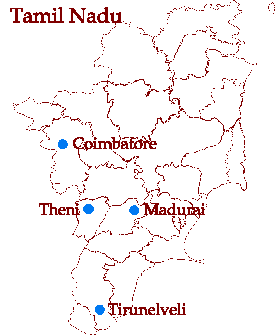
This post is on the request of one of my friends who asked me to write/post on any interesting material that we, the management guys(:-)) would come across. As someone who blindly loves his home town, it is natural that I post on the case which made my home town to appear in the map of one of the management books I study. If you are thinking about what I am talking about, just answer this connect question…


.

.

Connect Harvard Business Case Studies, A Small Temple Town in Southern Part of India and Cataracts…

.

.

It is none other than Aravind Eye Care Hospital.

Ø A role model for many hospitals and subject of study in many business schools

Ø A Hospital to which the Google co-founder and president (Products), Larry Page, flew down to look at the overall view of its functions.

Ø The only examination centre of the Royal College of Ophthalmology, United Kingdom, in the country

Ø Designated by the World Health Organisation as a collaborating centre for prevention of blindness


Its laurels are many.. But..


Until I was there in Tirunelveli, if somebody has talked about the Aravind Eye Care Hospital as an extraordinary and an exceptional organization, I would have probably laughed at him or her. For me then, it was just another hospital. I never knew its vision; I never knew its unique model; I never knew its achievements and Most of all I Never knew people in IIMs would know about it.

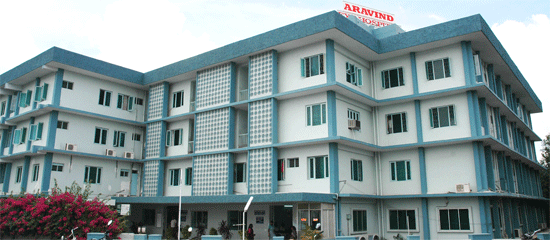
[Figure: Aravind Eye Hospital, Tirunelveli ...Cannot resist the temptation :-) ]


So what is special about Aravind Eye Care Hospital that it was published as a Harvard Business Case Study?


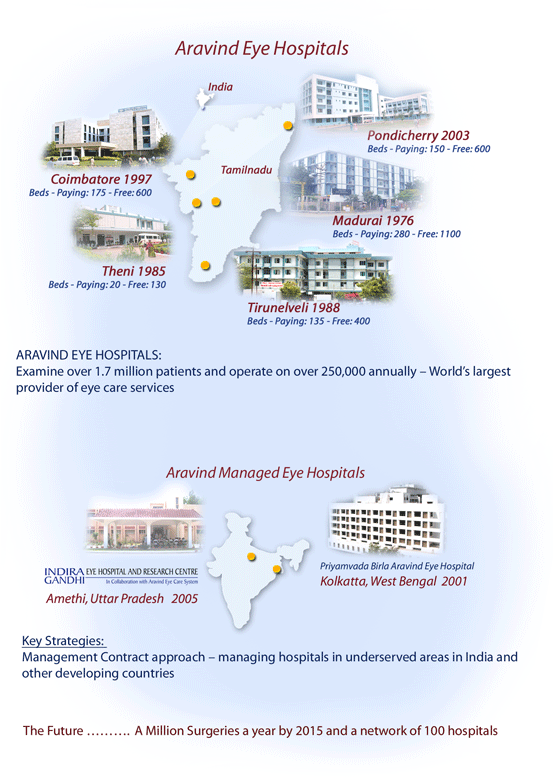
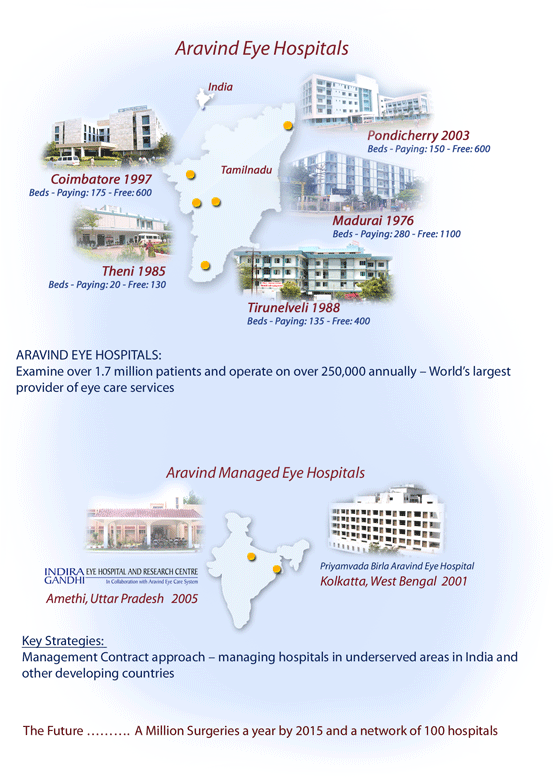
“With vision to remove needless eye blindness in India, Dr. Govindappa Venkataswamy started Aravind in 1976 as an 11-bed eye clinic in an old temple-city. Today it is the largest and most productive eye care facility in the world. Taking its compassionate services to the doorstep of rural India, Aravind's stunningly effective strategies vaulted barriers of distance, poverty and ignorance to create a self-sustaining system that now treats over 1.7 million patients each year, two-thirds of them, for free. “

Dr. Govindappa Venkataswamy fondly called as 'Dr. V'


USP of Aravind Eye Care Hospital:


Self-Sustaining Model:

The revenue generated from the "paying" patients offsets the cost of caring for the "free" patients. This type of cost shifting is nothing new. Then you realize that only about 30% to 40% of the patients are paying, and that paying is optional (i.e., a wealthy person can stay in the "free" hospital if he or she chooses). Aravind prides itself on being self-sustaining, i.e., no VIP donors, no government grants, and no bank loans. The technology is cutting-edge (all the newest phaco machines—the same models found in the United States, including the Alcon Infiniti).


Social Marketing:

“If Coco-colas can sell billions of soda and McDonalds can sell billions of hamburgers, why can’t Aravind sell millions of sight-restoring operations and eventually in the belief in the human perfection?” Ya! Aravind Eye care took the concept of social marketing to new heights.

To solve the problems in rural India, Aravind organizes camps to attract patients in rural India. If it finds someone for whom the operations are necessary, the hospital van picks them up and after three days are over when the surgery is completed, the patients return back to their home.


Management:

Aravind Hospital is a very good example of a well-conceived strategy platform. From 20 beds in 1976, it is now more than 2,500 in a four-hospital network.

Eye care is the motto, and patient's ability to pay is not focussed on. Cataract is concentrated on because "cataracts cause roughly 75 per cent of the 30 million cases of blindness in India". In 2002, it screened nearly 8 lakh patients free of charge and another 6 lakh for a fee.

The HBR mentions that the average ophthalmologist in India performs about 200 cataract surgeries a year, while "an Aravind doctor performs about 1,500 - an efficiency multiple of 7.5." How are they able to keep costs low? "In 1992, it decided to produce intraocular lenses in its own facility, Auro-Lab. It cut the cost of each lens to just $7, so by 2002, all patients were able to receive it."

There is also "the paying segment" which is important to nonprofits. In the case of Aravind, this segment subsidises the cost of free care, and also helps set the benchmark. "Paying clients set high demands on quality care, and those standards are used as a benchmark for non-paying clients as well."

It is not enough to have good intentions, because they say the path to hell is paved with only them. What is required is the application of the best of management tools and economic models to the delivery of service.

Dr. V by his single-minded focus and vision has shown us what is possible for a single person to achieve individually in the land where we live in. Is it not possible the same way for us also, to do something that the world would take note of?

.

.

“Are you in earnest? Seize this very minute;
What you can do, or dream, you begin it;
Boldness hath genius, power, and magic in it,
Only engage, and then the mind grows heated.
Begin; and then the work will be completed. “


- Johann Wolfgang Goethe